
India Bangladesh Relations 2026: Rising Tensions, Political Shifts and Border Crisis Explained
India Bangladesh Relations 2026: Rising Tensions, Political Shifts, and Uncertain Future
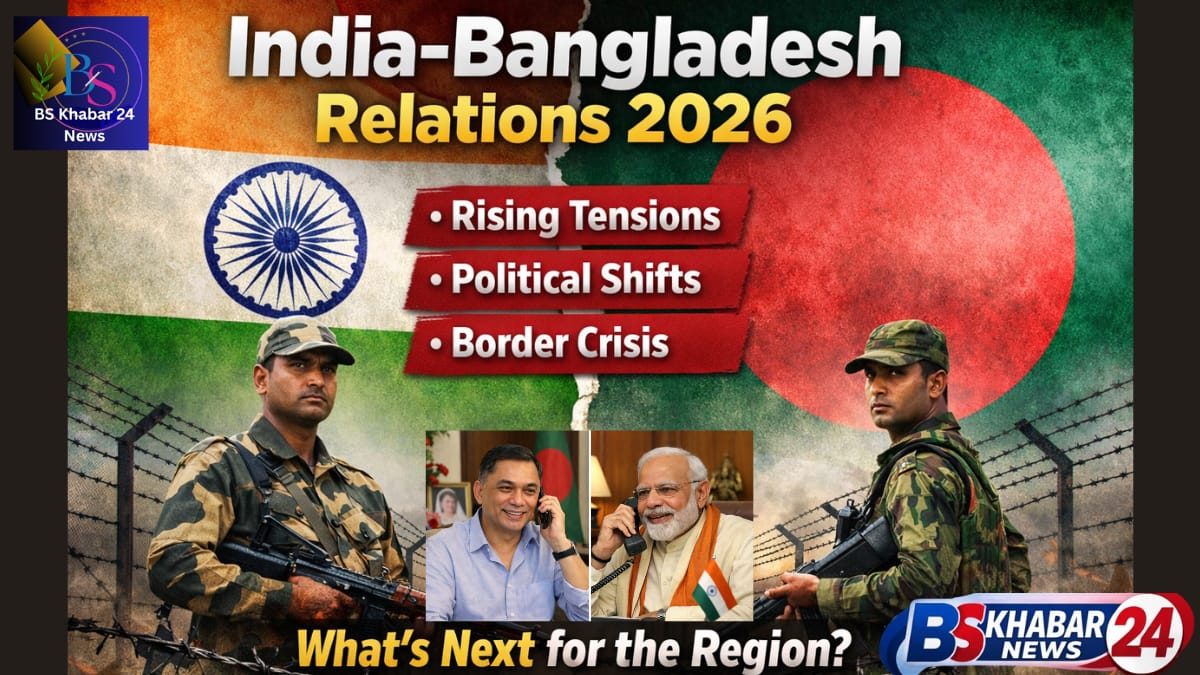
India and Bangladesh have always been friendly relations – shaped by history, politics, borders, culture and the emotional memories of 1971. But inIndia Bangladesh Relations 2026,the situation seems more uncertain than ever. Political changes within Bangladesh, a sharp public backlash in India and a growing diplomatic silence between the two governments have raised new concerns about the future of India-Bangladesh relations in 2026.
India-Bangladesh relations began at their worst during the interim government that is the focus of discussion today. The friendly relations deteriorated with the incessant anti-India dialogue by officials of the Yunus government.
In this detailed report by BS Khabar 24 News, we break down the key developments that shaped this important relationship.
Historical Background: A Friendship Born in 1971
The foundation of India-Bangladesh relations was laid during the 1971 Liberation War, when India supported Bangladesh’s struggle for independence from Pakistan. Crores of refugees entered India and the Indian government provided military and humanitarian assistance.
Temporary camps were set up and provided food, water, and free medical care for several months in India. Even various mass organizations in India were providing services day and night. At that time, under the able leadership of the late Prime Minister of India, Indira Gandhi, she continued her relentless service program despite the economic crisis.
After the victory, Bangladesh emerged as an independent nation with India’s cooperation. However, critics often argue that India did not set clear long-term strategic terms in 1971. Whether this was a diplomatic mistake or a gesture of goodwill is still debated.
In 2026, that historic connection is being re-negotiated as the relationship faces new challenges.
Hasina’s Asylum in India and Political Transition
One of the most dramatic developments was the departure of Sheikh Hasina from Bangladesh and her reported asylum in India. Her exit created a major political vacuum in Dhaka.
Soon after, an interim government was formed. This transitional administration promised stability, but its foreign policy signals quickly attracted attention in New Delhi.
The leadership shift directly impacted India Bangladesh Relations 2026, as India had maintained strong ties with Hasina’s government for years.
Rise of Younis and His Strong Anti-India Stance
The interim leadership under Younis adopted a noticeably tougher stance towards India. Public speeches emphasized “sovereignty” and an “independent foreign policy”, but critics interpreted some of the statements as anti-India.
Student leaders in particular and advisors to various departments were quick to make anti-India statements, and this was not without its social media and press coverage. Even the statements of the chief advisor, Nobel laureate Muhammad Younis, revealed an anti-India tactic. This is now being criticized by the people of both countries.
There have been reports of border tensions and diplomatic coldness. Although formal diplomatic relations remain intact, the warmth seen in previous years seems to have subsided.
Human Rights Allegations and Public Outrage
Several incidents in Bangladesh have attracted international attention, including allegations of communal violence and human rights violations.
One such incident involving Dipu Chandra Das has been widely reported in the media worldwide. Observers have described the incident as tragic and has heightened tensions in India-Bangladesh relations, especially among Indian citizens concerned about the safety of minorities.
Chinmoy Prabhu was arrested without charges, his demand was for minority development and security for Hindus, but will the next prime minister be able to provide security for minorities?
Because his father, Ziaur Rahman, was also killed. Fundamentalism is deep-rooted in this country, whether they admit it or not, but the reality is that bringing India into the mix is pointless.
In India, public opinion has hardened. Many citizens have expressed outrage over reports of persecution of Hindus in Bangladesh. Social media has amplified this emotion, increasing pressure on Indian policymakers.
Arrest of Chinmoy Prabhu Without Charge
Chinmoy Prabhu’s arrest without formal charges has sparked controversy. Human rights groups have demanded transparency, while political opponents have accused the interim government of suppressing dissent.
Hindus are not just in India, just as Muslims are not just in Bangladesh, people of different religions live together all over the world. But where were Younis and Tariq Rahman before? Who would have sheltered them from Christians and Jews? To the Bangladeshis in the north? Please comment. There was hope.
Such incidents are now part of a larger discussion about political stability and democratic practices in Bangladesh, which directly affects diplomatic trust.
Rise of Hard-Line Fundamentalist Groups
Another worrying development in India Bangladesh Relations 2026 is the reported rise of hard-line religious groups. Analysts believe that political instability often creates space for extreme voices.
India is closely watching this trend, especially given shared border security concerns. Stability in Bangladesh has always been important for peace in India’s northeastern states.
Return of Tarek Rahman After 17 Years
A major political twist came when Tarique Rahman, son of former Prime Minister Khaleda Zia, returned to Bangladesh after 17 years.
His return energized the Bangladesh Nationalist Party (BNP) and reshaped the political landscape.
On February 12, 2026, BNP secured a massive victory in the national elections. Soon after, Tarek Rahman was confirmed as Prime Minister.
This political shift has raised new questions about the direction of India Bangladesh Relations 2026, as BNP’s foreign policy priorities differ from the previous government.
Ban on Awami League
The announcement of the ban on the Awami League has shocked many observers. The party has long been associated with pro-India policies. In fact, he is a well-known acting captain of 85 years, which has been reflected in the last year and a half, and there is no reason to deny it, and proven in the world court.
With its ban, the political balance in Bangladesh has changed dramatically. India is now reassessing how to engage with the new leadership in Dhaka.
Border Tension and Security Concerns
Border issues are still sensitive in India-Bangladesh relations 2026. Occasional clashes, illegal crossings and allegations of smuggling have put pressure on trust.
Let us discuss further, the Indian Border Security Force (BSF) has handled the tension on the Bangladesh border in a very peaceful manner which is commendable. But the Bangladesh Border Guard (BGB) has played the role of a silent spectator as evidenced by the scenes circulated on social media and digital media.
Even Bangladeshi people did not pull the guns of the BSF, this happened in Kailashshahar, Tripura state of India. It has been circulated on all digital media. But very heartbreakingly, the Bangladesh BGB was a silent spectator.
But what is the use of saying, during this Yunis period, Bangladesh police were hung upside down and beaten to death, there was no such thing as law. But let’s see what Tariq Rahman Saab will do in time.
India’s Siliguri Corridor, often known as the “Chicken Neck“, which connects mainland India with its northeastern states, is also under discussion. Any strategic threat to this corridor is considered seriously by Indian defense planners.
Bangladesh’s Closer Ties with Pakistan
The news of Dhaka strengthening diplomatic ties with Islamabad has added another layer of complexity. Pakistan has not been slow to seize the opportunity. Which has stood in Bangladesh’s support for the World Cup T20.
But Bangladesh has not been able to seize the diplomacy of Pakistan, but today Pakistan-India is playing the T20 World Cup match in Sri Lanka. In this, Pakistan has given Bangladesh Cricket Board Chairman Aminul Islam Bulbul a dry sweet, which has no juice in the sweet.
Considering the historical background of 1971, any closeness between Bangladesh and Pakistan attracts the attention of India. Strategic observers believe that it can change the regional balance in South Asia.
Decision Not to Play T20 World Cup in India
Sports diplomacy was also affected when news broke that Bangladesh had decided not to participate in the T20 World Cup being hosted by India. This is also the political structure of Younis “Bangladesh will always do India”. Let me put it in our language “Where is the Rajrani, and where is the Bishnat Urinal”
Although officially described as a scheduling or administrative matter, many see it as a political signal. Sports often act as a bridge between nations, so such decisions affect public perception.
Public Sentiment: 40% Anti-India Feeling?
Some surveys suggest that nearly 40% of Bangladesh’s population currently holds anti-India views. While survey accuracy can vary, public opinion undeniably influences political leadership.
Similarly, in India, strong reactions to minority issues in Bangladesh have created emotional pressure on policymakers.
Public sentiment is now a key driver in shaping India Bangladesh Relations 2026.
Kashmir and Strategic Concerns
Some commentators compare India’s current Bangladesh approach with its historical experiences, including challenges in Kashmir.
They argue that strategic caution is necessary to avoid repeating past diplomatic mistakes. Whether these comparisons are fair or exaggerated remains debated.
Will India Make Another Historical Mistake?
A big question now is whether India will change its strategy toward Bangladesh.
Experts suggest three possible approaches:
- Diplomatic Engagement – Maintain dialogue and avoid confrontation.
- Strategic Pressure – Use economic or political leverage.
- Balanced Cooperation – Combine firmness with partnership.
Given the economic interdependence between the two nations, complete breakdown is unlikely. Trade, border cooperation, and cultural ties remain strong foundations.
Economic and Cultural Connections Remain Strong
Despite political tensions, trade between India and Bangladesh continues. India is one of Bangladesh’s largest trading partners. This is no longer true today, because India used to export silk to Bangladesh at very low prices, due to which the world’s second largest textile producing country like Bangladesh has reached the brink. Its great textile industry is on the verge of financial losses.
Even many workers have lost their jobs. There is no hesitation in saying that Yunus Saber’s anti-India stance has been demanded by the textile producers in their hearts.
Cultural exchange, shared language (Bangla), cinema, literature and family ties also act as emotional bridges.
This deep connection can save India-Bangladesh relations from a complete collapse in 2026.
What is the front position?
The future of India Bangladesh Relations 2026 will depend on several factors:
- Stability under Prime Minister Tarek Rahman
- India’s diplomatic response
- Border security management
- Protection of minorities
- Regional geopolitics involving China and Pakistan
Both countries have much to gain from cooperation and much to lose from confrontation
. Finally something
India and Bangladesh have a history, geography, culture and economic ties. But 2026 has brought new challenges. Leadership changes, political sanctions, human rights allegations and rising nationalism have become a source of uncertainty.
While tensions are real, diplomacy remains open. The coming months will be crucial in determining whether India-Bangladesh relations 2026 will move towards conflict or constructive engagement.
For the sake of regional peace and development, both countries need to prioritize dialogue, respect and mutual understanding. Otherwise, a developing country like India may lose out to Bangladesh, which is unthinkable.
Dear respected readers, if you enjoyed reading this report of BS Khabar 24 News, I end here with the hope that you will leave your valuable comments to encourage us. May everyone be well.


