
Jesse Jackson Death at 84: Civil Rights Icon and 1988 Michigan Political Trailblazer Passes Away
Jesse Jackson Death at 84: A Civil Rights Giant Who Shaped American Politics and Inspired Generations
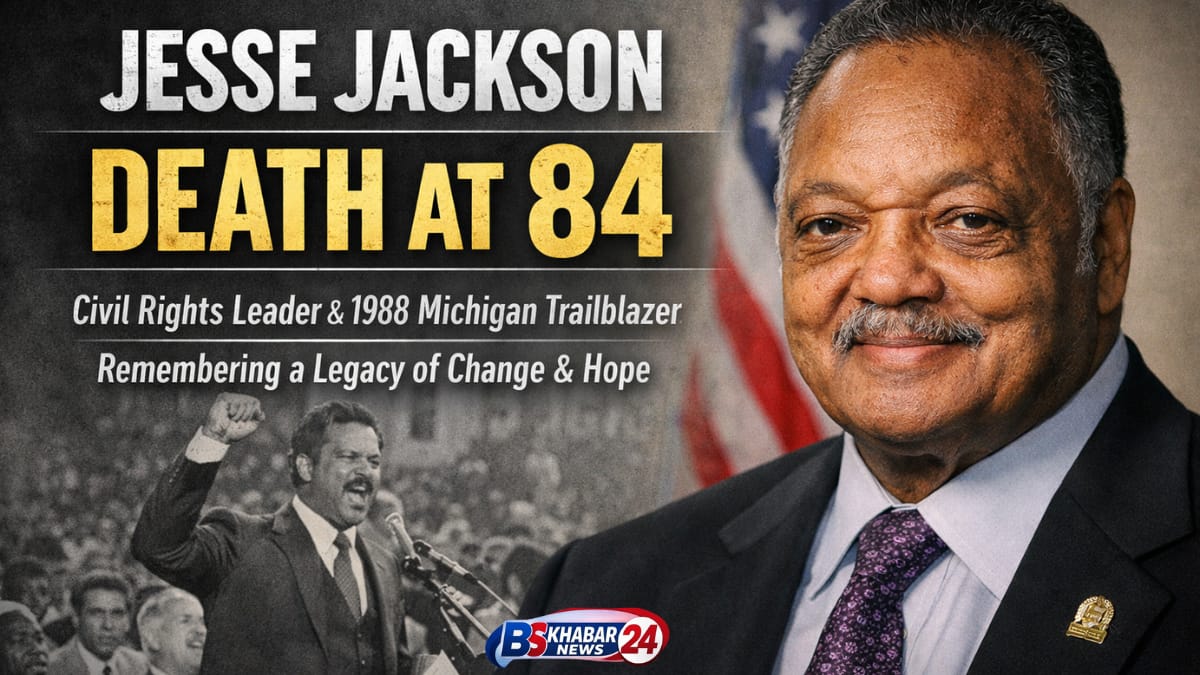
The news of Jesse Jackson’s death at the age of 84 has sent shockwaves across America and beyond. A shining figure in the civil rights movement, Jackson fought for racial equality, economic justice, and political empowerment for more than five decades. From marching with Dr. Martin Luther King Jr. to launching a historic presidential campaign, his journey was deeply intertwined with America’s struggle for justice.
Jackson died peacefully with his family by his side on Tuesday morning, according to a statement from the Rainbow Push Coalition. His death marks the end of an era in American civil rights history, but his impact continues to reverberate in communities across the country.
The news of Jesse Jackson’s death”Jesse Jackson death at 84” marks the loss of a brilliant leader in the American civil rights movement and the struggle for political power. Let’s begin our detailed discussion of Jesse Jackson.
Early Life and Rise in the Civil Rights Movement
Born in Greenville, South Carolina in 1941, Jesse Jackson grew up in the American South during a time of deep racial division. In the 1960s, he emerged as a passionate activist and became a close associate of Martin Luther King Jr. and a collaborator in his movement.
Jackson played a key role in the Southern Christian Leadership Conference (SCLC) and later founded Operation PUSH (People United to Save Humanity), which focused on economic empowerment and social justice. His ability to connect with ordinary people, combined with his powerful public speaking skills, quickly made him a national figure.
After King’s assassination in 1968, Jackson continued to advance his message of nonviolent protest and community organizing. Over time, he became one of the most recognized faces of the American civil rights movement.
Michigan’s Historic Role in His Political Journey
One of the defining chapters in his career came during the 1988 Democratic presidential race. Michigan played a critical role in elevating Jackson from activist to serious national political contender.
In a stunning upset victory in the state’s Democratic presidential caucuses, Jackson demonstrated that his message of inclusion and economic fairness resonated beyond traditional civil rights constituencies. Jesse Jackson death at 84, His Michigan win shocked political analysts and placed him firmly in the national spotlight.
The 1988 campaign was historic. Jackson built what he called the “Rainbow Coalition,” uniting African Americans, Latinos, labor unions, farmers, and working-class voters. While he did not secure the Democratic nomination, his campaign changed the conversation within American politics. Issues such as voting rights, economic inequality, and minority representation gained unprecedented visibility.
The Rainbow PUSH Coalition and Decades of Advocacy
Through the Rainbow Push Coalition, Jackson continued to bring communities together long after his presidential campaign ended. The organization became a powerful platform for voter registration drives, corporate accountability efforts, and social justice initiatives.
Over the years, Jackson has worked on the following issues:
- Expanding voter registration in minority communities
- Advocating for fair hiring practices
- Addressing educational disparities
- Supporting international human rights issues
- Helping to secure the release of American hostages in international conflicts
His work was not limited to the United States. Jackson also served in diplomatic roles abroad, helping to negotiate the release of American hostages in international conflicts. These efforts solidified his reputation as both a domestic reformer and a global humanitarian.
Health Battle Before Jesse Jackson Death at 84
In his later years, Jackson faced serious health challenges. He had been battling progressive supranuclear palsy (PSP), a rare neurological condition similar to Parkinson’s disease. The illness gradually affected his mobility and speech.
He was hospitalized on November 12 following complications related to the disease. Despite his declining health, Jackson remained symbolically active in public life, appearing at key events and continuing to advocate for social justice whenever possible.
The official statement confirmed that he died peacefully, surrounded by his loved ones. Tributes quickly poured in from political leaders, activists, and citizens who were inspired by his lifetime of service.
Political Reactions and National Tributes
Following the news of Jesse Jackson death at 84, leaders from both major political parties expressed condolences. Civil rights organizations described him as a “tireless change agent” who elevated the voices of the voiceless.
Former presidents, lawmakers, and community leaders highlighted:
- His groundbreaking presidential campaigns
- His lifelong fight against racial discrimination
- His commitment to nonviolent activism
- His dedication to empowering marginalized communities
Many observers noted that Jackson helped pave the way for greater minority participation in American politics, including future historic milestones.
A Legacy That Transformed American Politics
The impact of Jesse Jackson death at 84 goes beyond headlines. His legacy can be seen in the broader representation of diverse communities in government and civic life today.
Jackson was one of the first African American candidates to mount a serious campaign for the presidency within a major political party. His 1984 and 1988 campaigns expanded the Democratic electorate and influenced policy debates for decades.
Political analysts often credit him with:
- Expanding the concept of coalition politics
- Bringing economic justice into mainstream debate
- Encouraging minority youth to enter politics
- Inspiring grassroots activism across generations
Without his efforts, the political landscape of the late 20th and early 21st centuries might have looked very different.
Remembering the Man Behind the Movement(Jesse Jackson death at 84)
Beyond politics, Jackson was known for his charisma, powerful speeches, and unwavering optimism. His famous chant, “Keep hope alive,” became a rallying cry during his presidential campaigns and remains symbolic of his philosophy.
Supporters describe him as deeply committed to faith, family, and service. Critics sometimes challenged his methods, but few questioned his dedication to civil rights and equality.
Throughout his career, Jackson faced controversy, political opposition, and personal criticism. Yet he remained persistent, believing that meaningful change required courage and sustained effort.
What Jesse Jackson Death at 84 Means for the Civil Rights Movement
The passing of Jackson represents the closing of a historic chapter in the American civil rights movement. Many of his contemporaries from the 1960s era have already passed on, making this moment especially significant.
However, leaders within the movement stress that his vision continues through new generations of activists who fight for:
- Voting rights protections
- Criminal justice reform
- Economic opportunity
- Educational equity
Jackson’s life serves as a reminder that progress is often slow but possible through collective action.
Evaluation at the end
The story of Jesse Jackson’s death at age 84 is not just about the death of a political leader – it’s about the enduring power of activism and hope. From his early days for civil rights to his historic presidential campaign and decades of community organizing, Jackson left a profound mark on American society.
Dear BS Khabar 24 News readers, if you liked this article Jesse Jackson death at 84, please leave your valuable comments.


