
Tarique Rahman Becomes Bangladesh Prime Minister: Impact on India Relations
Bangladesh’s New Prime Minister Tarique Rahman and India-Bangladesh Relations Crisis
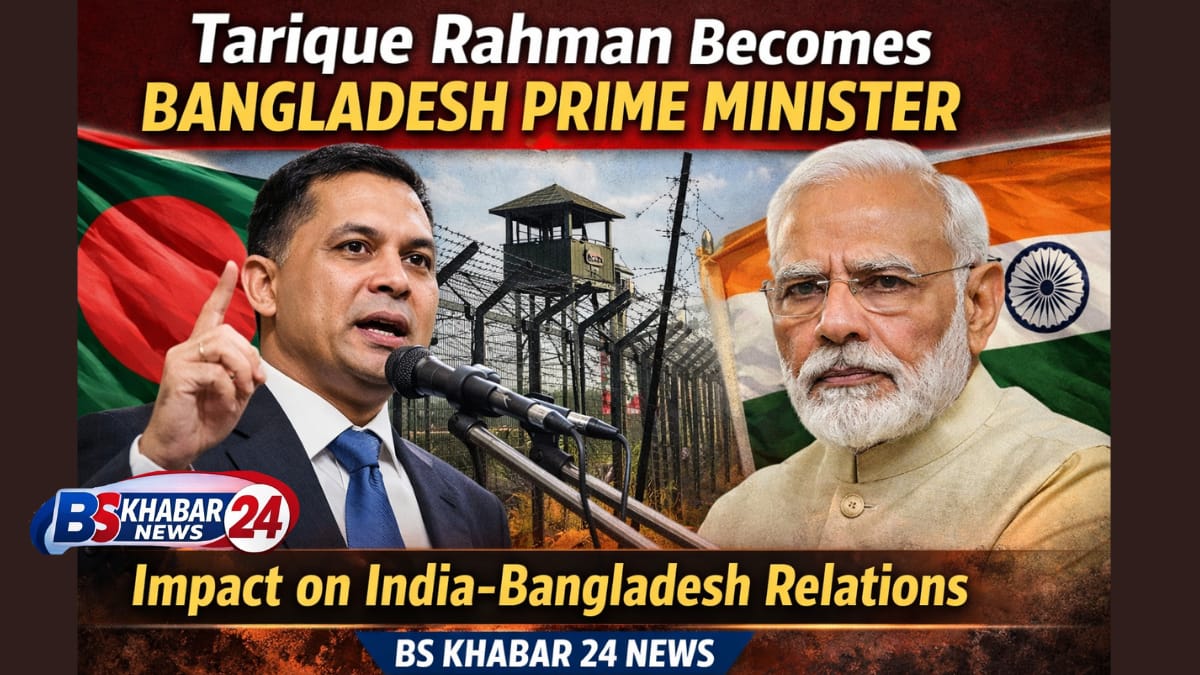
Dear readers, BS Khabar 24 News is presenting an important and deeply controversial development in South Asian politics today. Tarique Rahman, Bangladesh has witnessed intense political, social and diplomatic unrest for the past one and a half years. International media, human rights observers and regional analysts have closely monitored developments related to minority rights, political protests and changes in foreign policy.
The way the interim government, led by Nobel laureate Mohammad Yunus, has been encouraging the people of the country with anti-India sentiments for the past one and a half years is extremely worrying. Even the fact that he gave a farewell address to the people is worrying. Even if Tarique Rahman is the new Prime Minister, it has become difficult to keep the trust of the people of India. But what the Indian government will say on foreign policy, only the government can say.
Bangladesh has witnessed intense political, social and diplomatic unrest. International media, human rights monitors and regional analysts have closely monitored developments related to minority rights, political protests and changes in foreign policy.
Now, a historic political moment has unfolded. After 17 years away from the country, Tarique Rahman, the son of former President Ziaur Rahman, has returned to Bangladesh and been sworn in as the new Prime Minister after a popular election victory.
The event is being seen as a turning point not only for Bangladesh’s domestic politics but also for the future of India-Bangladesh relations.
A Dramatic Return After 17 Years,Tarique Rahman
For nearly two decades, Tarique Rahman remained outside Bangladesh amid legal and political controversies. His return signals a significant shift in the country’s political landscape. Supporters describe it as a democratic comeback through the ballot, while critics raise concerns over the direction of governance and policy under his leadership.
The swearing-in ceremony marked a new chapter in Bangladeshi politics. Crowds gathered in Dhaka, celebrating what they called a “new era.” However, political analysts note that this new era begins under heavy regional and diplomatic scrutiny.
The Minority Question: A Global Concern
Over the past 18 months, Bangladesh has faced serious allegations of violence and intimidation against minority communities, particularly Hindus. Various international organizations and foreign media outlets have reported incidents of unrest, property damage, and targeted attacks.
The killing of Dipu Chandra Das, a young Hindu from the minority, is one of the most infamous in the world. Where language has no place, there is Chinmoy Prabhu, but the fact that the new Prime Minister, Tariq Rahman, has not uttered a word on the matter before or after his election is telling.
The situation has drawn global attention. Observers argue that ensuring the safety, equality, and constitutional protection of minorities will be one of the biggest challenges for the new government.
The stability of any democracy depends on how it protects its vulnerable communities. The new administration’s approach to minority rights will affect both domestic harmony and international perception.
Farewell Speech and Anti-India Sentiment
Nobel laureate and former chief advisor Muhammad Yunus’ farewell address was a key discussion point. In his speech, he made some statements that many have criticized India’s influence in the region.
He highlighted Bangladesh’s strategic openness to regional waterways and emphasized potential trade partnerships involving Nepal, Bhutan, and the northeastern states of India (often called the “Seven Sisters”).
These comments have sparked debate among political analysts. Some see them as a strategic move for regional economic integration, while others interpret them as a sign of a realignment – even a distancing – from India.
And this has left many Hindus thinking, “This time, we can live in peace.” And our analysis says that it is time to pour water on the ground. We believe that no matter which government comes to power in Bangladesh, your fight should reach the world. And it should also be remembered that radical fundamentalism, they are so radical that it will be difficult to defend your religion.
India-Bangladesh Relations at a Crossroads
Bangladesh’s new Prime Minister Tarique Rahman and the India-Bangladesh relationship crisis — reflecting the core of the risk.
Historically, India and Bangladesh have shared deep cultural, economic and strategic ties. From trade partnerships to border management and security cooperation, the two countries have relied on mutual understanding.
However, political change often brings policy changes. If Dhaka adopts a more assertive or independent regional stance, it could create diplomatic friction. But this is not a permanent solution for India, because it has created a permanent rift between the peoples of the two countries. Mr. Yunis made it clear in his own words. This is not our business.
India’s leadership, including Prime Minister Narendra Modi, will likely assess the evolving situation carefully. National security experts and foreign policy strategists will be closely monitoring Bangladesh’s regional moves, especially on connectivity routes and strategic waterways.
Strategic Importance of Northeast Connectivity
The geopolitical importance of Bangladesh for the northeastern states of India is immense. Trade routes, transit corridors and river access play a vital role in regional development.
However, it is very unfortunate and regrettable that Younis has made the remark of separating the northeast of India, i.e. Chekinneck. Then there has been a backlash between the people of the two countries, which the leaders can resolve but not the people. But in our analysis it is irresponsible.
If Bangladesh strengthens economic cooperation with Nepal and Bhutan and redefines its relationship with the northeastern region of India, then it will be possible to reshape the balance of power in South Asia.
However, diplomatic relations are rarely static. They develop through dialogue, economic interests and strategic realities.
Public Sentiment and Political Narrative
Public opinion within Bangladesh seems divided. Supporters of the new prime minister “Tarique Rahman” believe that his leadership will restore economic momentum and establish national sovereignty. Critics fear that polarization and diplomatic isolation will increase.
Bangladesh must be remembered, geographical location, neighborhood, taste of independence, developing India, all are India’s contributions to 1971. “You can talk with your eyes open, it’s hope or not” position, power must not be forgotten. Hope for the development of the country and the nation is right, but it is better not to overdo it.
Political rhetoric often intensifies during a change of leadership. The most important thing now is policy implementation – how the government manages internal law and order, minority protection and regional diplomacy.
The Economic Factor,Tarique Rahman
Bangladesh and India are major trading partners. Bilateral trade is worth billions of dollars annually. Any significant strain in the relationship could affect trade, border markets and regional infrastructure projects.
In the last one and a half years, the world’s second largest cotton producing country, called “Bangladesh”, has been in a tailspin. This thought did not cross Mr. Yunus’ mind, yes it did. But he is 85 years old, he thought he would make a name for himself globally. There was no need to worry for the people of Bangladesh. Look, we are just taking the reality that is being reported in all the media, that is all we have analyzed.
Economic realism often resolves political differences. Both countries understand the value of long-term tensions.
Security and Diplomatic Calculations
Regional stability in South Asia requires careful balancing. Cross-border security cooperation has historically benefited both countries. Any breakdown in communication could create vulnerabilities.
Foreign policy experts suggest that while strong political statements may dominate headlines, long-term relations are shaped through diplomatic channels behind closed doors.
India, as a regional power, will likely engage diplomatically rather than react emotionally.
What Lies Ahead? Tarique Rahman
The coming months will be crucial.
- Will the new government prioritize minority safety and national reconciliation?
- Will diplomatic channels between Dhaka and New Delhi remain open and constructive?
- Will economic interests outweigh political rhetoric?
Only time will provide clarity.
For now, the focus keyword Bangladesh’s New Prime Minister Tarique Rahman and India-Bangladesh Relations Crisis captures a defining moment in regional politics.
Final Analysis from BS Khabar 24 News
At BS Khabar 24 News, we believe in analyzing developments from every angle. Political transitions are always complex. Emotions may run high, and rhetoric may appear confrontational. But international relations are rarely black and white.
Bangladesh’s new leadership faces enormous responsibility:
- Protecting minorities
- Maintaining internal stability
- Managing foreign relations strategically
India, too, must respond with diplomatic maturity and long-term vision.
South Asia’s future depends not on confrontation but on calculated engagement.
As history has shown, political landscapes change — but geography does not. Bangladesh and India will always remain neighbors. Whether their relationship strengthens or weakens will depend on decisions made in the coming months.
BS Khabar 24 News will continue to monitor every development closely and bring you fact-based, balanced updates.
Only time will tell how this new chapter unfolds.


