
How India Detected F-35 Stealth Fighter: Inside India’s Anti-Stealth Radar Network
How India Detected F-35 Stealth Fighter: Inside India’s Anti-Stealth Radar Capabilities
Date: 29-01-2026[BS Khabar 24 News]
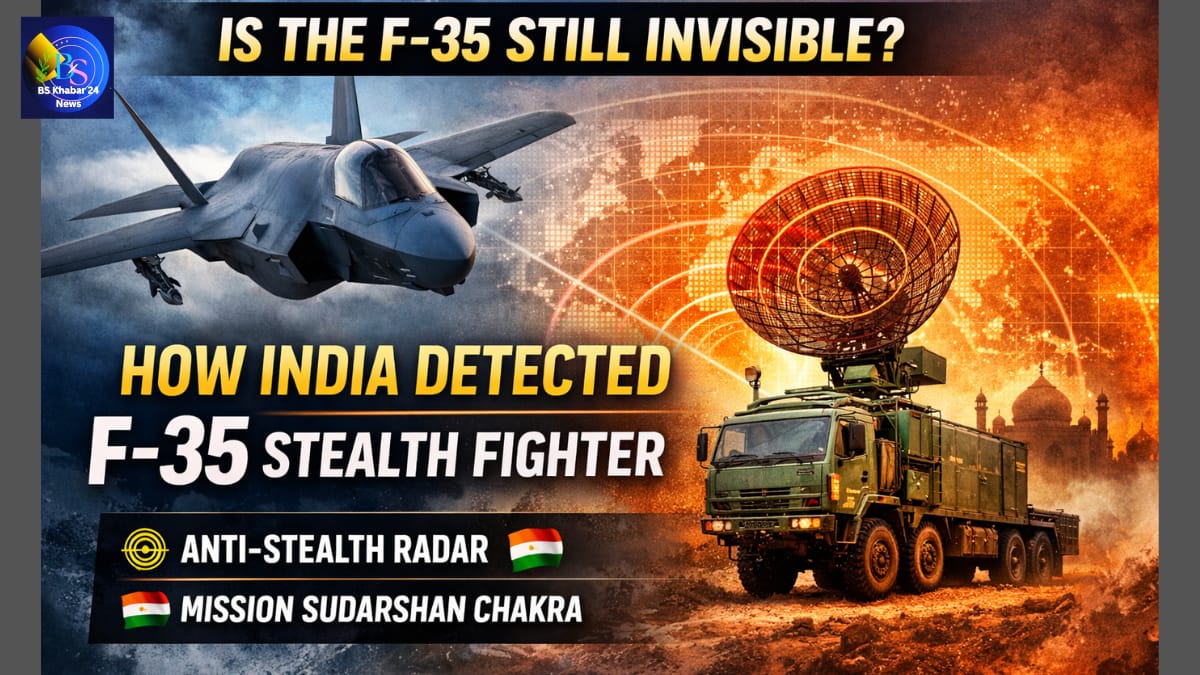
The F-35 Lightning II is widely regarded as the world’s most advanced stealth fighter jet, designed to evade even the most sophisticated air defence systems. India detected F-35 stealth fighter, Developed by the United States, the aircraft relies on cutting-edge stealth technology, sensor fusion, and electronic warfare to remain nearly invisible to enemy radar. However, recent defence discussions and expert analyses have raised an intriguing question: How did India reportedly detect an F-35 stealth fighter?
Although neither India nor the United States has issued any official confirmation, defense experts believe that India’s growing anti-stealth radar capabilities may have played a significant role in challenging the long-held notion that stealth aircraft are completely undetectable. India detected F-35 stealth fighter,The current “India is a modern India” narrative means that India is a country of immeasurable significance in global politics, particularly in defense and information technology, and is a subject of much discussion worldwide.
Understanding the Myth of “Invisible” Stealth Fighters
Stealth does not mean total invisibility. Aircraft like the F-35 are designed to reduce radar cross-section, making detection difficult, not impossible. Traditional radars operating in higher frequency bands often struggle to track stealth aircraft, but modern warfare has moved beyond single-layer radar systems.
India, over the past decade, has quietly invested in multi-layered radar networks, passive sensors, and data fusion technologies that can detect even low-observable targets under the right conditions and “India detected F-35 stealth fighter”.
India’s Multi-Layer Radar Strategy
India detected F-35 stealth fighter,Defence analysts point out that India does not rely on one single radar system. Instead, it uses a network-centric air defence approach, combining multiple radar bands, satellite inputs, and airborne early warning systems.
Key factors that may have enabled detection:
- Low-Frequency Radar Systems
Stealth aircraft like the F-35 are optimized to avoid high-frequency radars. However, VHF and UHF band radars, which India reportedly operates, can sometimes detect stealth shapes due to their longer wavelengths. - Passive Radar Technology
Passive radars do not emit signals. Instead, they track reflections from civilian broadcasts such as FM radio, TV signals, or satellite transmissions. Since the F-35 cannot detect or jam these systems easily, passive radar networks can expose stealth movements. - Sensor Fusion & AI-Based Tracking
India’s defence ecosystem increasingly relies on data fusion, where inputs from ground radar, airborne platforms, satellites, and electronic intelligence are merged into a single operational picture. Artificial intelligence helps identify anomalies that might otherwise be ignored.
The Role of “Mission Sudarshan Chakra”
Defence commentators have linked India’s anti-stealth progress to a broader strategic concept often referred to as “Mission Sudarshan Chakra”—a term used to describe India’s layered air defence vision rather than an officially announced program.
The idea behind this strategy is simple:
Even if a stealth aircraft avoids one radar layer, it cannot avoid them all.
By overlapping multiple detection methods—active radar, passive sensors, infrared tracking, and electronic intelligence—India aims to track stealth platforms long enough to respond, even if a weapons lock is not immediately achieved.
Why F-35 Detection Matters Strategically
If stealth aircraft can be tracked—even intermittently—it changes the balance of air power. Detection does not automatically mean interception or destruction, but it allows defenders to:
- Adjust air defence postures
- Scramble interceptor aircraft
- Track flight paths and operational patterns
- Reduce the psychological dominance of stealth platforms
This development reflects a global trend. Countries like Russia, China, and now India are heavily investing in counter-stealth technologies, signalling that the age of uncontested stealth may be coming to an end.
India-US Military Balance: Cooperation, Not Conflict
It is important to note that India and the United States are strategic partners. Reports about F-35 detection are best understood in the context of joint exercises, simulations, or analytical assessments, not hostile encounters.
In fact, such developments may encourage deeper military cooperation, technology sharing, and realistic assessments of future battlefield conditions rather than confrontation.
What This Means for the Future of Air Warfare
The reported ability to detect stealth aircraft underscores a crucial reality: no technology remains unbeatable forever. As stealth advances, so do counter-stealth systems.
India’s progress in this area highlights its transformation from a technology importer to a defence innovator, capable of developing indigenous solutions tailored to modern threats.
Final Thoughts
So, how did India detected F-35 stealth fighter ?
Not through a single breakthrough, but through years of investment in layered radar systems, passive detection, and smart data integration.
While the F-35 remains one of the most formidable aircraft ever built, India’s evolving air defence network proves that stealth is no longer a guarantee of invisibility. In modern warfare, information dominance matters just as much as firepower—and India is clearly strengthening its position on that front.


